evolution as it is defined at dictionary.com:
"A gradual process in which something changes into a different and usually more complex or better form"
my question is, how does something change into a more complex form? a more complex DNA structure I take it?
how do you add to one's genetic code?
how do you get from a single cell organism to multicell organism?
question related to evolution
There are theories for that (which I'll leave up to the more knowledgeable people here to explain), but my impression is that, if we had a clear answer for that question, evolutionary theory wouldn't even be a debate.
All we really have is theories, based on the strong evidence of today's organisms compared with that of ancient ones, with no real proven timeline of an evolutionary change being realized.
All we really have is theories, based on the strong evidence of today's organisms compared with that of ancient ones, with no real proven timeline of an evolutionary change being realized.
Mutations...if a mutated lifeform has better chances of survival, it'll more chance of spreading its genes. For example, bacteria duplicate fast and they have lot of mutations during their mitosis. If you use antibiotics you will kill a lot of bacteria, but maybe a few mutated bacteria will survive. If you stop the antibiotics too early, a few mutated and unresponsive strains will survive and the next time you use that antibiotics they'll developed resistence.
That's just one part, it's much more complicated. It's interesting to see that a non-vertebrae like an octopus has developed eyes as well, but the nerve cells of the retina are on the backside instead of on the frontside like with our eyes.
The environment has a lot of influence on the adaptation of a life-form but how that all translates to cellular and DNA level, I dunno
That's just one part, it's much more complicated. It's interesting to see that a non-vertebrae like an octopus has developed eyes as well, but the nerve cells of the retina are on the backside instead of on the frontside like with our eyes.
The environment has a lot of influence on the adaptation of a life-form but how that all translates to cellular and DNA level, I dunno
You should do some search on "symbiotic evolution", that's a very interesting and likely theory about single cell organisms working together.
Our human cells with nucleus are an example of that. The eukaryotic cells all have mitochondria inside, mitochondria were once independent cells (bacteria if you will) and they're incorporated in our cells since they do the oxidative cyclus of burning fuelmolecules with endproducts of carbondioxide and water. Without them we couldn't have used oxygen for our highburning metabolism.
Our human cells with nucleus are an example of that. The eukaryotic cells all have mitochondria inside, mitochondria were once independent cells (bacteria if you will) and they're incorporated in our cells since they do the oxidative cyclus of burning fuelmolecules with endproducts of carbondioxide and water. Without them we couldn't have used oxygen for our highburning metabolism.
I thought about mutations, but how can a mutation be carried on to the next generation? a chromosomal mutation? I take it there IS such thing
so in fact to for an extreme interpretation, humans in one hand are just the product of countless misshaps, heh serendipity at it's best
ps pext it did say "more complex OR better form"
so in fact to for an extreme interpretation, humans in one hand are just the product of countless misshaps, heh serendipity at it's best
ps pext it did say "more complex OR better form"
the crazy thing is that the mutation has to be on the chromosomes in cells that are used for meiosis, i.e. the reproductive cells that divide their number in half so it can merge (eggs, sperm).
p.s. this applies to humans of course
p.s. this applies to humans of course
Last edited by saturn on Fri May 13, 2005 6:05 pm, edited 1 time in total.
A mutation is carried to the next generation in the same way all genetic information is. However, a mutation might only have a limited chance of being passed on (based on the Law of Random Assortment). Also, if the mutation is detrimental and the organism can't reproduce before it dies, the mutation won't be passed on. At all other times, it will be passed on like everything else.
well mutations allways happen to single individuals... so there's no magical generation x that has telekinesis or something like that. however - if these single individuals happen to survive, they spread their DNA. that's why evolution is rather slow.
on the other hand this depends on the reproduction rate of the species.
as an analogy: there is no global 'update' from version 1.1 to 1.2.
the rate at wich mutations occur is, again, part of the evolution process as a species could either be to static or to unstable.
on the other hand this depends on the reproduction rate of the species.
as an analogy: there is no global 'update' from version 1.1 to 1.2.
the rate at wich mutations occur is, again, part of the evolution process as a species could either be to static or to unstable.
-
Guest
I'd say enviroment determins most types if not all types of evolution. Basicly a need creates mutations. The need is usualy biological and is usualy required because of the enviroment. I'd say as humans we probably ceased evolving in any kind of traditional sense since we control our enviroments so much better than any other creature.
An good example of what I'm saying though would be the inuits. They have an extra vertebre in their back because of prolonged periods sitting down doing reptetetive tasks which is easier if you have an extra bone in your back.
An good example of what I'm saying though would be the inuits. They have an extra vertebre in their back because of prolonged periods sitting down doing reptetetive tasks which is easier if you have an extra bone in your back.
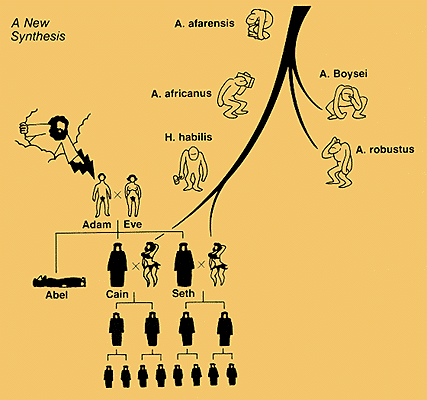
Quoted basically because we need more pics of hot ape chicks in bikinis. But why, out if interest, is africanus holding a ghetto blaster? Hmmmm....Hannibal wrote:
P.S. @ Kracus: :icon27: :icon27: :icon27: :icon27: :icon27: :icon27: :icon27: :icon27: :icon27: :icon27: :icon27: :icon27: :icon27: :icon27: :icon27: :icon27: :icon27: :icon27:
no, a need harbours mutations -- i get born with a very high advantage at mathematics, for example, go to university, earn lots of money and have 4 kids, those kids have a much higher chance of being mathematically gifted like i am (even more so if i shack up with some geeky chick)Kracus wrote:I'd say enviroment determins most types if not all types of evolution. Basicly a need creates mutations. The need is usualy biological and is usualy required because of the enviroment. I'd say as humans we probably ceased evolving in any kind of traditional sense since we control our enviroments so much better than any other creature.
 hence, the mutation lives on and we've gone from 1 person with suparmath, to 5.
on the other hand, if i get born with really bad or no eyesight (*pauses during post writing to wipe glasses*), i can't get a driver's licence due to it being a major disability, i can't get a decent job so i live off my disability pension until i get hit by a car that i didn't see coming, the amount of people with my gene has gone from 1, to 0.
in conclusion, evolution wins and shut up kracus i hope your genes go from 1 to 0 kthx.